Learning to See Beauty
Personalized Ranking from Portrait Comparisons
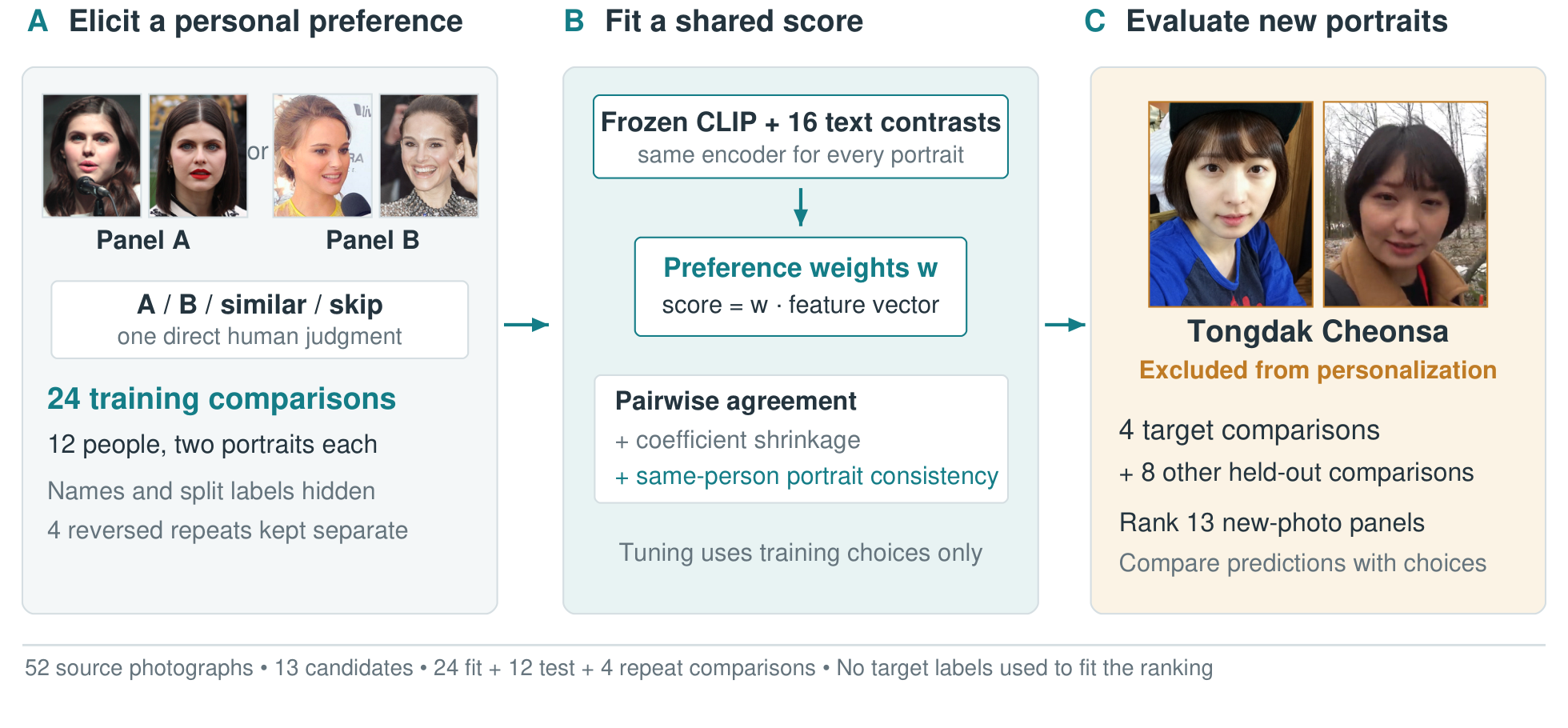
Can preferences learned from one observer’s portrait comparisons transfer to new photographs and an unseen person?
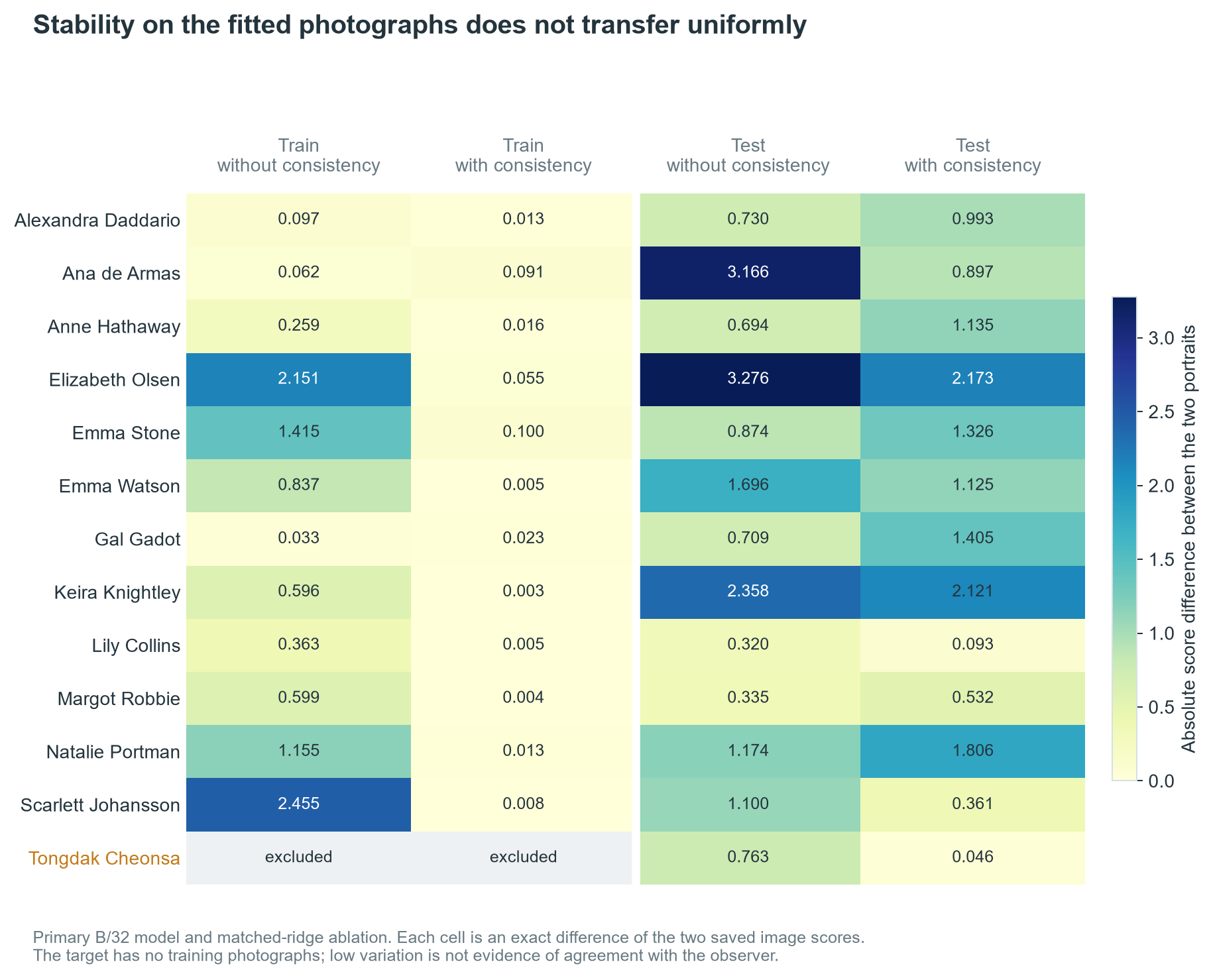
More stable scores did not reliably predict preference.
Models were fitted to 24 choices and evaluated on 12 comparisons using different photographs. Excluding one held-out tie, the main model matched 3/11 choices. Removing only the consistency term from the same representation yielded 2/11; an identity-only baseline matched 9/11.
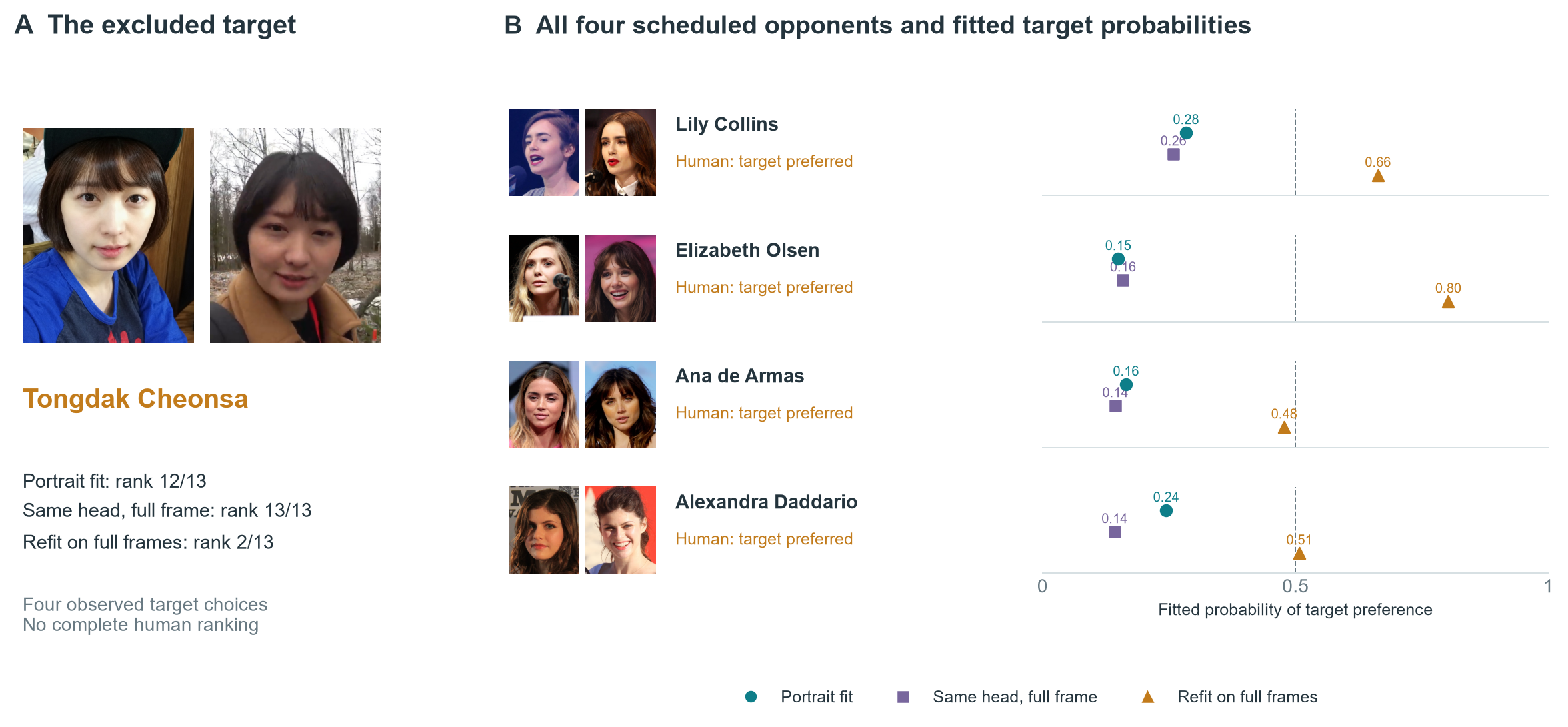
The observer preferred Tongdak Cheonsa to all four scheduled opponents. The main model missed all four comparisons and ranked her 12th among the 13 panels. These four choices do not establish the observer’s complete ranking of all 13 people.
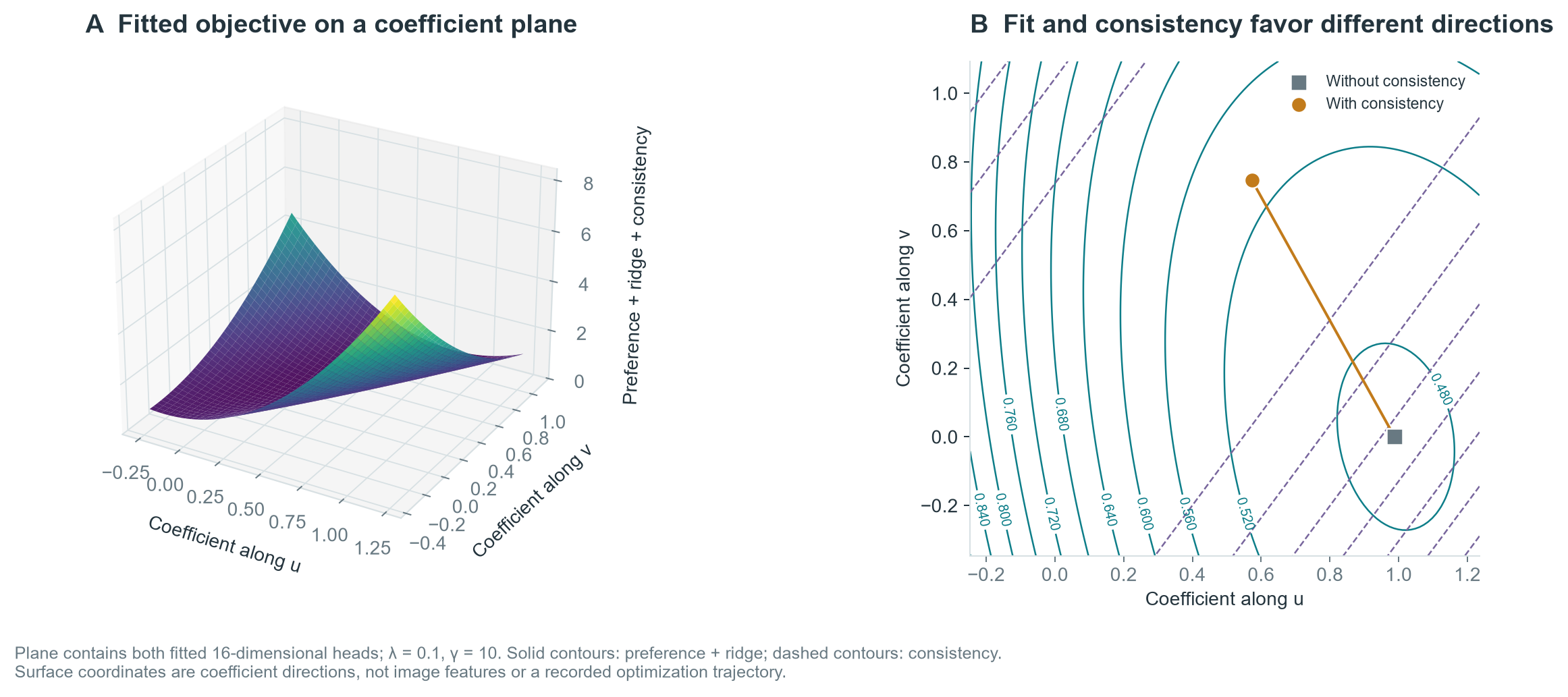
The consistency term reduced within-identity score variance from 0.3254 to 0.000472 on fitting photographs, and from 0.6704 to 0.4036 on held-out photographs. Rankings also changed substantially when refitting on the original framing or changing the encoder. The rankings below are model outputs.
Same portraits, different models
Panels are ordered by the mean score of two held-out photographs. Original-framing conditions are compared with the same responses collected using cropped photographs; they are not a separate validation of preferences for the original images.
Loading records…
Sources and licenses for all 52 photographs
Crops are derivatives of the listed source images. Actress photographs retain their individual Creative Commons licenses. No Creative Commons license is assigned to the user-supplied Tongdak Cheonsa photographs. Source dates may refer to publication rather than capture.
Results and computations
Figures were generated from the saved features, predictions, and responses. Seven conceptual diagrams are editable in diagrams.net; quantitative plots can be regenerated with the included Python code.
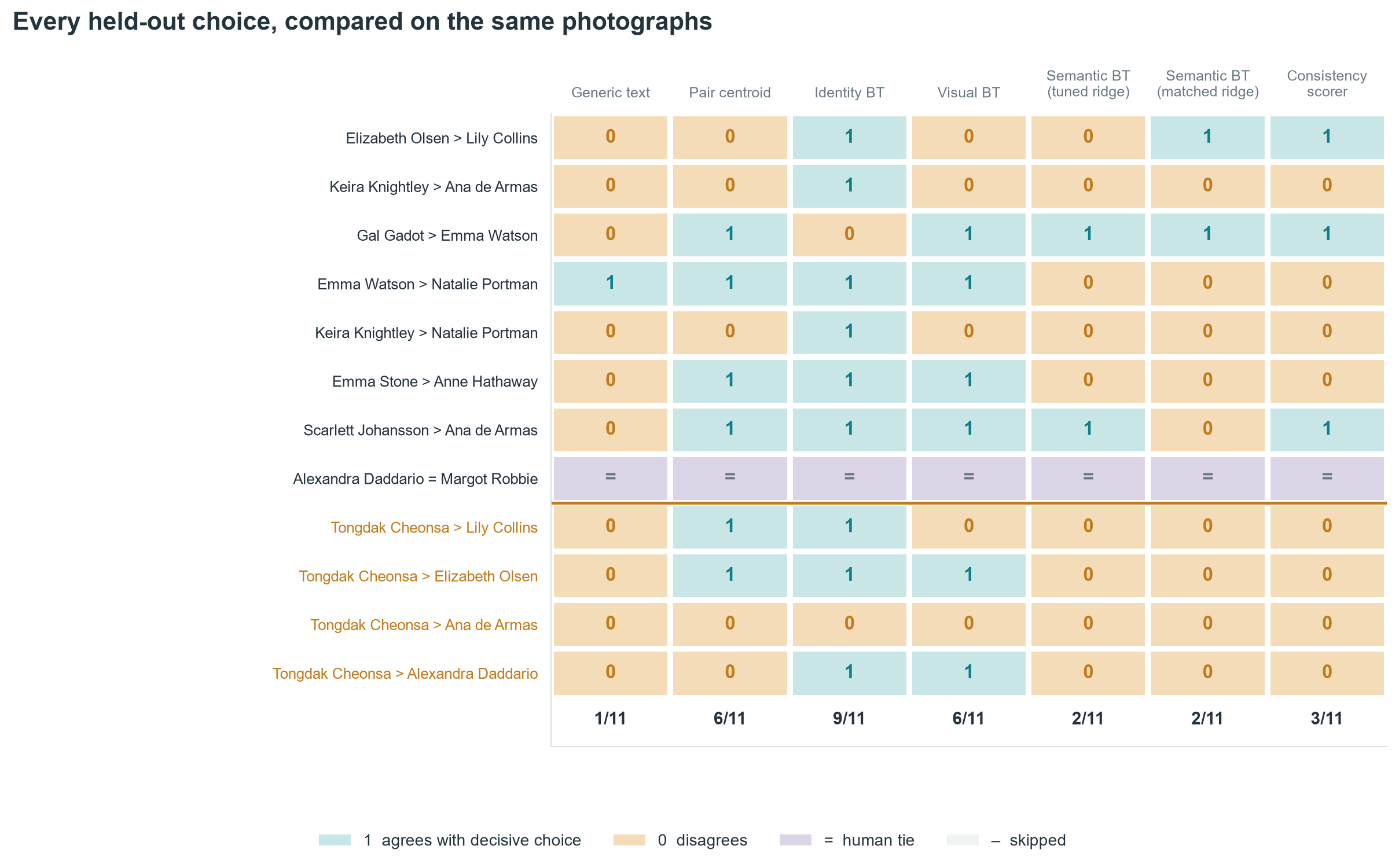
All 40 observed choices
The session contained 24 fitting comparisons, 12 comparisons with different photographs, and four repeats with left and right reversed. Names and split labels were hidden from the observer. All four repeated choices agreed with their originals.
| Order | Split | Left | Right | Choice |
|---|
Paper, source images, and code
All archives extract into one chicken-angel-beauty folder. Model weights are not bundled; rerunning feature extraction downloads the pinned public checkpoints. The saved features support reproducing fitting, evaluation, and figures.
Each archive includes a SHA-256 manifest. Downloaded literature PDFs are not redistributed. This is a case study of one observer and a fixed photograph collection, presented as an independent preprint using the official NeurIPS 2026 format.